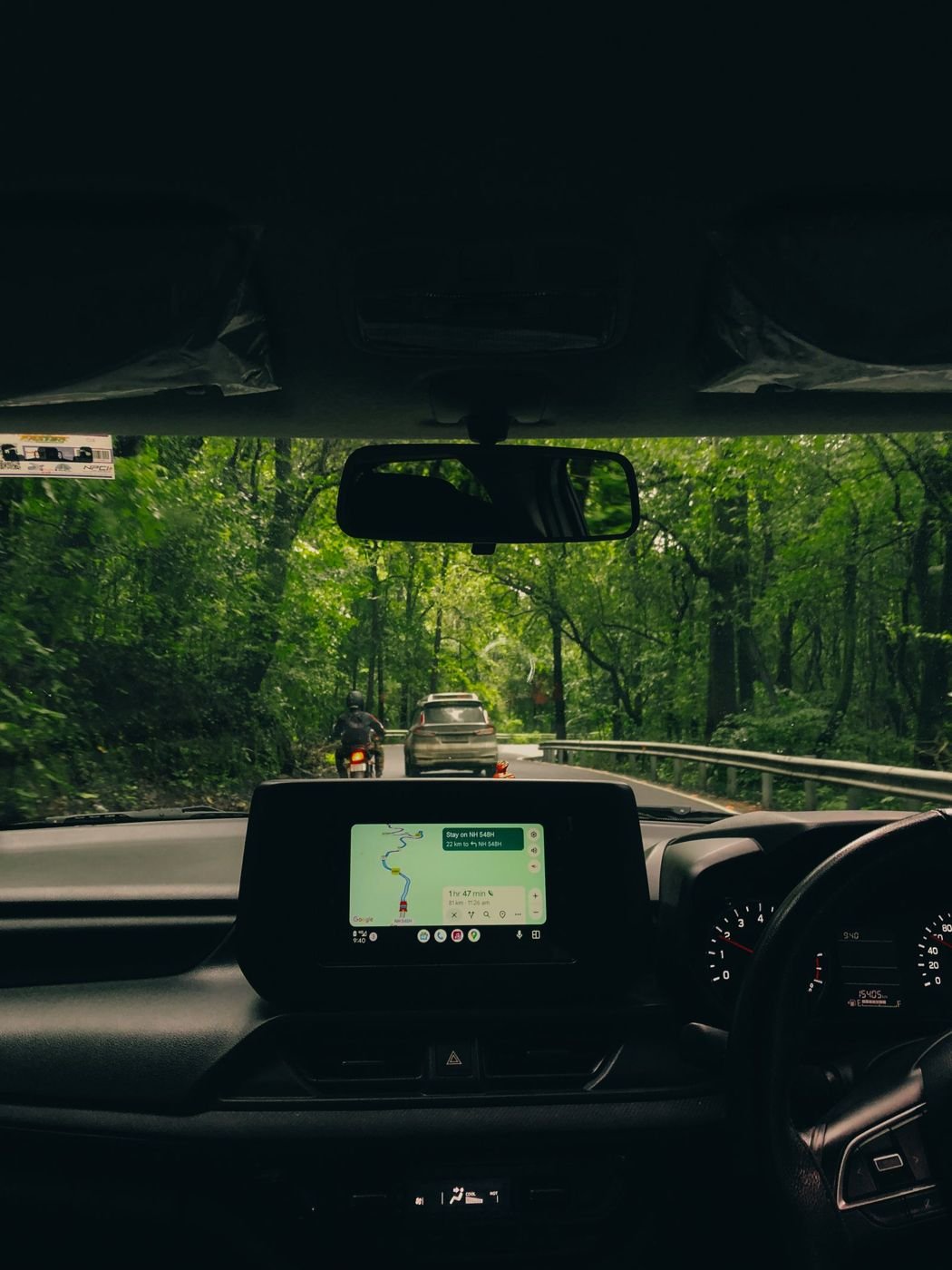
You’ve spent months driving the same eight miles to work and back, and now you’re about to put a family and four suitcases into a car for a 400-mile trip. That’s the moment the checks before a long drive earn their keep, because a car that’s fine on a commute can show its weak spots after three hours on a motorway.
This is a routine for the evening before you leave. It takes about half an hour, needs no tools beyond a tyre gauge and a torch, and covers the car, what you carry, and the driver, which is the part most checklists skip. The rules and sources are from the UK and the US, with each rule marked as UK or US.
The checks before a long drive, in the order to do them
Do them in this order and you won’t have to go back to anything. Tyres come first because they’re the only part of the car touching the road, and the checks that need daylight go before the ones you can do in the dark.
| Check | What you’re looking for | Time | Where the standard comes from |
|---|---|---|---|
| Tyre pressure | Every tyre at the figure on the car’s sticker, spare included | 5 min | US Department of Energy and EPA (fueleconomy.gov) |
| Tread and damage | At least 1.6mm across the central three-quarters (UK); no cuts, bulges or exposed cord | 5 min | UK DVSA, 2014 |
| Oil, coolant, screenwash | Levels between the min and max marks | 5 min | Your owner’s manual; Ready.gov lists what to have checked |
| Lights and indicators | Headlights, brake lights, indicators, hazards all working | 5 min | Highway Code rule 89 (UK) |
| Wipers and washers | Clean sweep, no smearing, jets reach the screen | 2 min | Ready.gov (US) |
| Warning lights | Nothing lit on the dashboard after the engine starts | 1 min | Owner’s manual |
| Emergency kit | Warning triangle or flares, jump leads, phone charger, blanket | 5 min | Ready.gov (US) |
| The driver | Slept, route planned, breaks scheduled, medicines checked | 5 min | Highway Code rules 91 and 96 (UK) |
Tyres: where most long-trip problems start
Pressure
Find the recommended pressure on the sticker inside the driver’s door jamb or in the glove box, or in the owner’s manual. The US Department of Energy’s fueleconomy.gov site, run with the EPA, says to ignore the maximum pressure printed on the sidewall of the tyre. That number is what the tyre can withstand, not what your car should run.
Check before you drive anywhere, and use the figure on the door sticker or in your owner’s manual. Check the spare too.
Pressure also costs you money. The same Department of Energy page says under-inflated tyres can reduce fuel economy by about 0.2% for every 1 psi drop in the average pressure across all four tyres.
Example: say your sticker says 35 psi and all four tyres read 30. That’s a 5 psi drop, so roughly a 1% hit. If your car uses about 14 gallons over a 400-mile trip, 1% is about 0.14 gallons. It isn’t a fortune. The better reason to fix it is that you’re about to load the car, so check whether your sticker or manual lists a separate pressure for a full load or sustained motorway speeds.
Tread, cuts and bulges
In the UK, the legal minimum tread depth for a car is 1.6mm across the central three-quarters of the tread. The Driver and Vehicle Standards Agency (DVSA) explained how it is measured, in guidance for MOT testers, in a 2014 post on its Matters of Testing blog, which adds that the outer quarter can be bald without failing the check.
The same post says you only need to measure the primary grooves, meaning the ones with the tread wear indicators in them. The post says the sidewall is usually marked with a small arrow or the letters TWI to show where the indicators sit.
If you drive in the US, tread limits are set at state level, so check your own state’s rule, and use a tread gauge rather than a coin if you want an actual number. Either way, run your hand slowly around each tyre and look at the sidewalls. A bulge, a cut or any exposed cord means the tyre needs replacing before the trip, however much tread is left.
A tyre that passes the legal minimum can still be the wrong tyre for 400 miles at 70 mph. Treat the minimum as the line you must not cross, not the target.
Fluids and warning lights
Ready.gov’s emergency preparation list is a useful guide to what a pre-trip service should cover. Ready.gov’s car safety page says to have a mechanic check the antifreeze, battery and ignition system, brakes, exhaust, filters, heater and defroster, lights, oil, thermostat, and the wipers and washer fluid. You can do the first part yourself in ten minutes.
- Oil. Park on level ground, let the engine cool for a few minutes, pull the dipstick, wipe it, push it back in fully, and read the level against the marks. If it’s near the minimum, top up with the grade your manual specifies.
- Coolant. Look at the reservoir only when the engine is cold, and never open the cap on a hot engine. The level should sit between the two marks.
- Screenwash. Fill it. A long motorway drive behind a lorry will use more than you think.
- Dashboard. Start the engine and watch the warning lights. Most go out within a few seconds. A light that stays on is a reason to visit a garage before the trip, not during it.
If your brake pedal feels spongy, the car pulls to one side when you brake, or you’ve noticed a grinding noise, skip the DIY checks and book a garage. Those are faults you shouldn’t carry 400 miles.
Lights, wipers and being seen
Rule 89 of the UK Highway Code says your vehicle and any trailer must comply with the construction and lighting regulations, which in practice includes working lights. The quickest way to test them alone is to park facing a wall or garage door at night, switch on the lights, and see what reflects. For brake lights, back up to a window or shop front and watch the reflection while you press the pedal, or ask someone to stand behind the car.
Check the indicators on both sides, the hazards, the fog lights, and the number plate light. Then run the wipers on a dry screen with a squirt of washer fluid. If they smear or judder, the blades are due for replacement, and they’re cheap.
What to carry
Ready.gov’s list for a car kit includes booster cables, flares or a reflective warning triangle, a car phone charger, a blanket, a paper map, and an ice scraper in cold weather. Ready.gov separately advises keeping the tank full in case of evacuation or power outages. For a long drive, add water, a small snack, any regular medication, a torch, and a high-visibility vest. Rules on carrying a warning triangle and vest vary by country, so check the ones for the countries you’ll drive through.
Keep a paper map in the glove box for when the phone dies or the signal drops. Put the heaviest items in first, low down and as close to the rear seats as you can, and keep the load below the line of the rear window so nothing shifts under braking.
The part checklists skip: the driver
The car is only half the equation. Rule 91 of the UK Highway Code, which covers tiredness, recommends that you get enough sleep before a long journey and avoid long journeys between midnight and 6am, when natural alertness is at its lowest. It also recommends a break of at least 15 minutes after every two hours of driving, and it says that if you feel sleepy you should stop in a safe place and not on the hard shoulder of a motorway.
Rule 96 covers medicines: check with your doctor or pharmacist, and don’t drive if you’re told you may be impaired. That’s worth doing the day before, not at the pharmacy counter on the way out of town.
Example: a 400-mile trip at an average moving speed of 55 mph takes about 7 hours 15 minutes of driving. Following rule 91, you’d stop after about two, four and six hours, so that’s three breaks of at least 15 minutes, which brings the journey to roughly 8 hours. Tell the people expecting you to plan for eight, not seven.
A plan you can text to someone
Before you leave, send a short message to a relative or friend. It takes a minute and gives anyone looking for you a place to start.
- Where you’re going and the route you’ll take.
- Your planned stops, with the times you expect to reach them.
- The registration number and colour of the car.
- When you expect to arrive, and when you’ll message to say you have.
Your night-before checklist
- All four tyres and the spare at the pressure on the door sticker, checked before the car has been driven
- No cuts, bulges or exposed cord on any tyre, and tread looked at on the primary grooves
- Oil, coolant and screenwash levels checked and topped up if needed
- No dashboard warning lights after starting the engine
- Headlights, brake lights, indicators and hazards tested
- Wipers clean and the washer jets working
- Warning triangle or flares, jump leads, charger, torch, blanket, water and a paper map in the car
- Licence, insurance and breakdown cover details to hand
- Medicines checked with a doctor or pharmacist if there’s any doubt
- Route planned, breaks marked every two hours, and a message ready to send to someone at home
- Fuel tank filled, so the first stop isn’t forced on you
Common mistakes
The most frequent one is checking tyre pressure after a drive. A reading taken on warm tyres will look higher than the true cold figure, so you let air out and end up under-inflated.
The second is forgetting the spare. A flat found at the roadside is far worse when the replacement is also soft, and a spare that’s been in the boot for two years is the one most likely to be.
The third is doing all of this at 7am on departure day. Rushed checks get skipped, and a flat spare or a failed bulb found the night before is a ten-minute problem. Found at the roadside, it’s a lost afternoon.
The takeaway
Half an hour the evening before covers the car, the kit and the plan. Check the tyres first and when they’re cold, look at the fluids and lights second, pack the emergency kit third, and treat the driver as part of the vehicle: slept, medicated safely, and ready to stop every two hours.