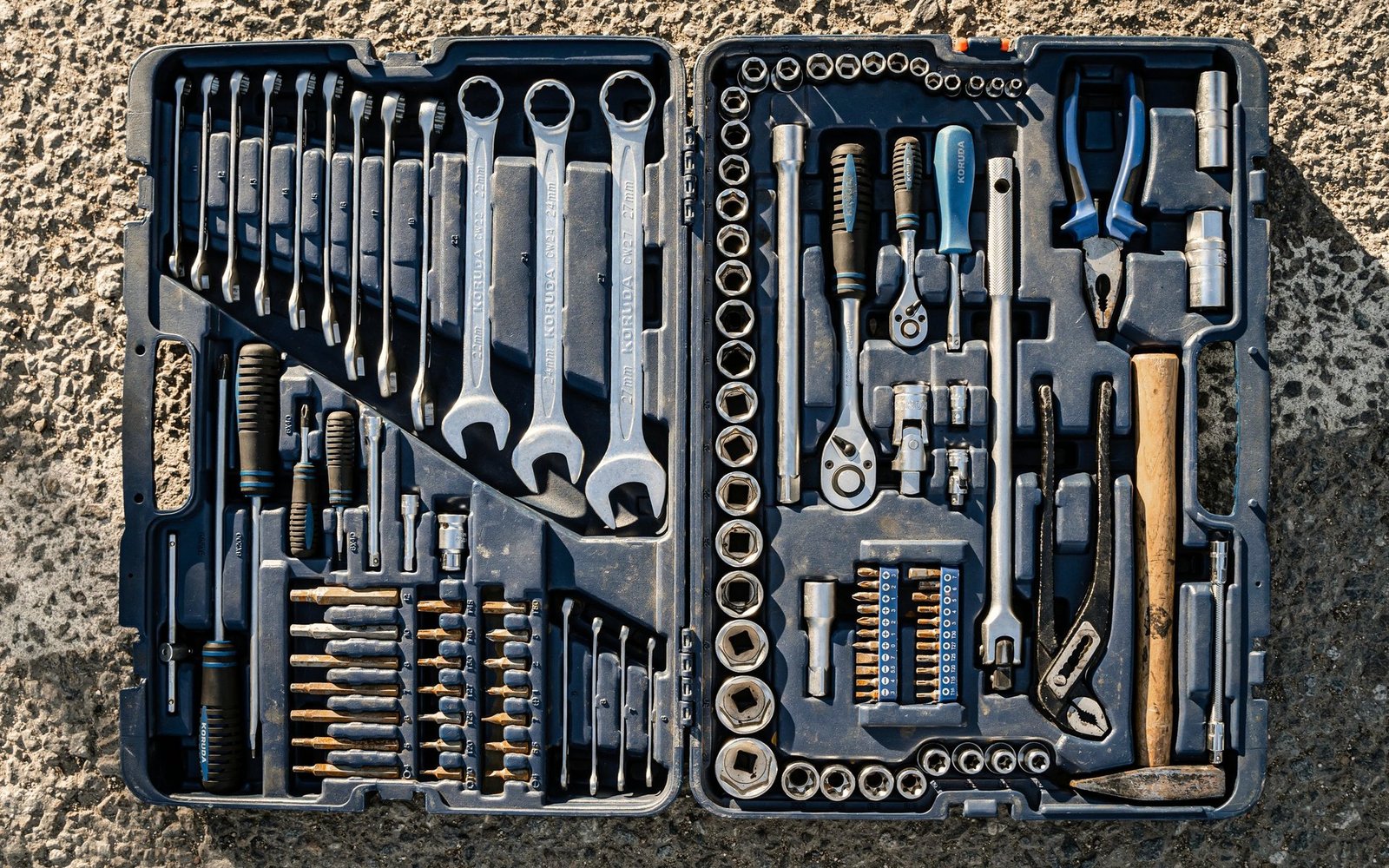
This guide is for anyone who keeps borrowing a screwdriver from a neighbour, or who has a drawer of odd tools and no idea which ones they need. It covers a small set of tools that will handle most household jobs, what each is for, where it pays to buy better quality, and how to store and use them without hurting yourself.
You don’t need a workshop. A sturdy box and around a dozen well-chosen tools will get you through hanging pictures, putting together flat-pack furniture, tightening loose hinges and plenty of other small repairs.
The core tools
Start with these. Between them they cover most jobs you’ll meet in a flat or a house.
Claw hammer
A medium-weight claw hammer drives nails and pulls out bent ones. Choose one that feels balanced in your hand and isn’t so heavy that you tire after a few swings. A rubber or textured grip helps when your hands are sweaty.
Screwdrivers
You need two head types at minimum: flat (slotted) and cross-head. Cross-head screws come in two common patterns, Phillips and Pozidriv, which look alike but aren’t the same. Using the wrong one chews up the screw head.
A set with two or three sizes of each covers most needs. A screwdriver with interchangeable bits takes up less space, but make sure the bits sit firmly and don’t wobble.
Tape measure
A 5-metre tape measure with a locking button is enough for most rooms. Look for clear markings in the units you use, and a hook at the end that moves slightly. That movement is deliberate: it allows for the hook’s own thickness, so readings stay accurate both when you hook it over an edge and when you push it against a wall.
Spirit level
A level shows whether a shelf, picture or curtain rail is straight. A 60cm level suits most household jobs. A short torpedo level fits in tight spaces and is handy to have as well.
Pliers
Combination pliers grip, bend and cut light wire. Long-nose (needle-nose) pliers reach into small spaces and hold tiny parts. Together they cover a lot of fiddly work.
Adjustable spanner
One adjustable spanner of medium size tightens and loosens nuts and bolts of many sizes. It won’t replace a full spanner set for car or bike work, but for loose tap fittings and furniture bolts it does the job.
Utility knife
A retractable utility knife with replaceable blades opens boxes, trims carpet and scores plasterboard. Swap blades often. A blunt blade needs more force, and that’s when it slips.
Cordless drill
If you buy one power tool, make it a cordless drill-driver. It drills holes for wall plugs and drives screws far faster than you can by hand. Look for a model with adjustable torque (the clutch) so you don’t drive screws too deep or strip them. Add a small set of drill bits for wood, metal and masonry, plus a few screwdriver bits.
Allen keys and a stud finder
Allen (hex) keys come with most flat-pack furniture, but a proper set is easier to use and won’t round off. A simple stud and cable detector helps you find timber studs to fix into, and warns you about pipes and wires before you drill.
Useful extras
Once the basics are covered, these make life easier:
- A small hand saw for trimming timber
- A set of wall plugs and assorted screws in a divided box
- Masking tape for marking drill positions and protecting surfaces
- Sandpaper in a few grades
- A torch or head torch for working under sinks and in cupboards
- A step stool or small stepladder (a chair is not a substitute)
Where to spend more and where to save
Not every tool needs to be top quality. A rough guide:
| Tool | Worth spending more? | Why |
|---|---|---|
| Screwdrivers | Yes | Soft tips deform and damage screws |
| Cordless drill | Yes | Batteries and motors vary a lot in lifespan |
| Tape measure | Somewhat | Cheap tapes kink and the markings wear off |
| Spirit level | Somewhat | A level that isn’t true is worse than none |
| Hammer | Not much | A basic one lasts for years |
| Utility knife | Not much | The blade matters more, and blades are cheap to replace |
A simple way to check a level in the shop or at home: set it on a flat surface and note the bubble, then turn it end to end in the same spot. The bubble should sit in the same place both times.
Storing your tools
Good storage means you can find things quickly and tools don’t get damaged.
- Keep everything in one toolbox or bag, so you aren’t searching three rooms.
- Store tools somewhere dry. Damp leads to rust, especially on pliers and saw blades.
- Put small fixings in a divided box with labels.
- Keep blades retracted or covered, and drill bits in their case.
- If there are children in the house, store the box out of reach, and keep screws, nails and blades in it, not loose in a drawer.
Charge cordless drill batteries before a job, not on the day you need them, and store them as the manufacturer recommends.
Safety basics
Most DIY injuries come from rushing or from using the wrong tool. A few habits cut the risk a lot.
- Use the right tool for the job. A screwdriver isn’t a chisel or a pry bar, and pliers aren’t a hammer.
- Check tools before you use them. Loose hammer heads, cracked handles and frayed power cables should be fixed or replaced, not used.
- Cut away from your body. Keep your free hand behind the blade and work on a stable surface.
- Wear eye protection when drilling, hammering or cutting anything that might chip or splinter. Safety glasses are cheap.
- Check for cables and pipes before drilling into walls. Use a detector, and avoid drilling directly above, below or beside sockets and switches, where cables often run.
- Use a proper step stool or ladder. Never stand on a chair, a box or a wobbly table.
- Unplug or remove the battery before changing drill bits.
If you use corded power tools, a residual current device (RCD) cuts the power quickly if something goes wrong. Electrical Safety First explains how RCDs work and how to check whether your home has one.
If a job involves mains wiring, gas, or structural walls, stop and call a qualified tradesperson.
Rules on who can carry out electrical and gas work differ between countries, so check your local requirements before you take on anything beyond basic repairs.
Common mistakes
- Buying a large, cheap “200-piece” set and finding that the pieces you actually use bend or break.
- Using the wrong screwdriver type, which strips screw heads.
- Overtightening screws in flat-pack furniture, which splits the board.
- Drilling without checking for cables or pipes.
- Leaving tools in a damp shed or car boot.
Checklist
- Claw hammer, flat and cross-head screwdrivers, tape measure, spirit level
- Combination and long-nose pliers, adjustable spanner, utility knife with spare blades
- Cordless drill-driver with a basic bit set
- Allen keys and a stud and cable detector
- A dry toolbox, a box of labelled fixings, and safety glasses
- Spend more on screwdrivers and the drill, less on the hammer
- Check walls before drilling, and call a professional for wiring, gas or structural work