General information only, not medical advice. If you have a health condition, an injury or have not exercised for a long time, check with a doctor or physiotherapist first.
This guide is for an adult who walks, cycles or does some cardio but has never lifted weights: perhaps someone in their thirties who feels intimidated by the gym floor, a busy parent with twenty minutes after the children are in bed, or someone in their fifties who has noticed that getting up from the floor is harder than it used to be. Strength training sounds like a young person’s hobby. It is one of the most useful things any adult can do for everyday life, and it can start in the living room.
Why strength matters
The NHS physical activity guidelines for adults recommend strengthening activities that work all the major muscle groups, legs, hips, back, abdomen, chest, shoulders and arms, on at least two days a week. That is in addition to 150 minutes of moderate aerobic activity.
Many people meet the aerobic target through walking or sport but skip strength entirely. Yet strength underpins everyday tasks: carrying shopping, climbing stairs, lifting children, getting up from a low chair and keeping your balance.
How hard is hard enough
The NHS says that to get health benefits from strength exercises, you should do them to the point where you need a short rest before repeating the activity. That is the working definition of effort for a beginner: the last couple of repetitions should feel challenging, not impossible.
What counts as strength training
It does not have to mean barbells. The NHS lists activities including:
- Lifting weights
- Working with resistance bands
- Bodyweight exercises such as push-ups, sit-ups and squats
- Heavy gardening, such as digging and shovelling
- Yoga, pilates and tai chi
- Carrying heavy shopping bags
- Lifting and carrying children
Any of these can work, as long as they challenge the major muscle groups.
Before you start
Set up a safe space
You need a clear area of floor, a sturdy chair without wheels or arms, and a wall. The NHS’s home strength routine recommends a solid, stable chair that will not slip, and loose, comfortable clothing.
Warm up
Spend five minutes marching on the spot, rolling your shoulders and swinging your arms gently. Warm muscles move better.
Learn the movement first
Do each exercise slowly at first, focusing on form. Speed and load come later.
The last couple of repetitions should feel challenging. That is the signal you are working hard enough.
The beginner routine
This routine uses bodyweight and a chair, and covers every major muscle group. Several exercises are adapted from the NHS’s home strength exercises, which recommend starting with around five repetitions and building up gradually.
| Exercise | Muscles | Starting point |
|---|---|---|
| Sit-to-stand | Legs, hips | 5 slow repetitions |
| Wall press-up | Chest, shoulders, arms | 5 to 10 repetitions |
| Mini-squat holding the chair | Legs, buttocks | 5 repetitions |
| Calf raise holding the chair | Calves | 5 repetitions |
| Standing leg extension | Buttocks, back of thighs | 5 each side, holding for up to 5 seconds |
| Bird dog (on hands and knees) | Back, abdomen | 5 each side |
| Glute bridge (lying on your back) | Buttocks, hips | 8 repetitions |
| Bent-over row with water bottles or bags | Upper back, arms | 8 each side |
Key technique points
- Sit-to-stand: sit on the edge of the chair with feet hip-width apart, lean slightly forward and stand using your legs, not your arms. The NHS notes that the slower the repetitions, the better.
- Wall press-up: stand at arm’s length from the wall, hands flat at chest height, and bend your elbows to bring your chest towards the wall, keeping your back straight.
- Mini-squat: hold the back of the chair, bend your knees as far as is comfortable, keeping them facing forward, and squeeze your buttocks as you come up.
- Glute bridge: lie on your back with knees bent, feet flat, and lift your hips until your body forms a straight line from shoulders to knees.
- Row: hinge forward at the hips with a flat back, one hand on the chair, and pull a full water bottle or bag of shopping towards your hip.
Do one round of all eight exercises, rest for a minute, then repeat. Two or three rounds take about 20 minutes.
How to progress
Your body adapts to the demands placed on it, so the routine needs to get harder over time. The NHS’s home routine suggests gradually increasing repetitions; on its separate strength guidance, it gives examples such as attempting three sets of five to ten repetitions.
Ways to make it harder
1. More repetitions. Add one or two each week until you reach about 12 to 15 with good form.
2. More rounds. Move from two rounds to three.
3. Harder versions. Progress from wall press-ups to press-ups against a kitchen worktop, then knees on the floor, then full press-ups. Move from mini-squats to full squats, then to lunges.
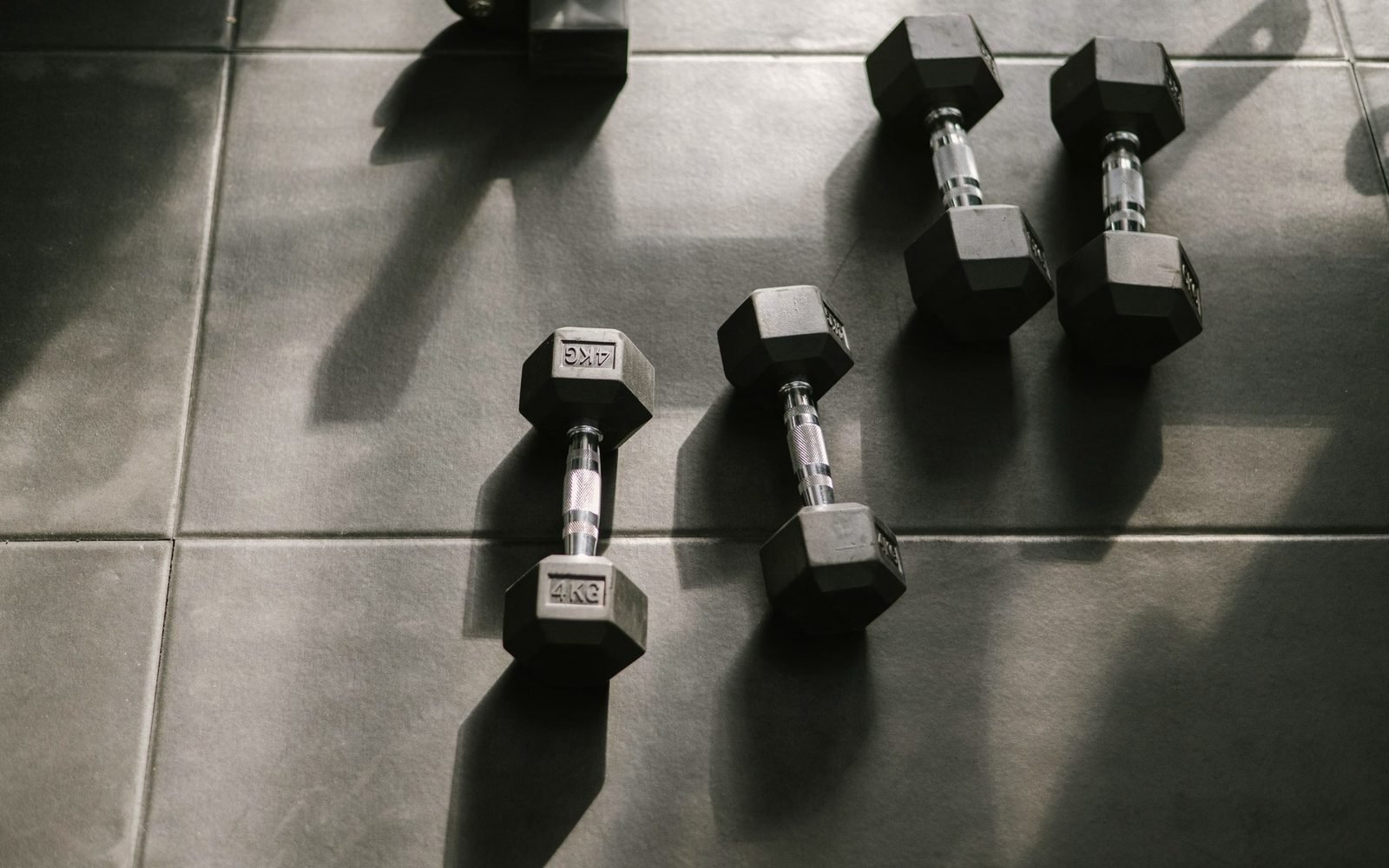
4. Add load. Use resistance bands, a backpack filled with books, or a pair of adjustable dumbbells.
5. Slow down. Taking three seconds to lower each repetition makes any exercise harder.
Change one thing at a time, and only when the current level feels manageable for all repetitions.
A 12-week plan
| Weeks | Sessions per week | Rounds | Repetitions | Focus |
|---|---|---|---|---|
| 1 to 2 | 2 | 2 | 5 to 8 | Learn the movements |
| 3 to 4 | 2 | 2 | 8 to 10 | Steady control |
| 5 to 6 | 2 to 3 | 3 | 10 to 12 | Build volume |
| 7 to 8 | 2 to 3 | 3 | 8 to 10, harder versions | Progress exercises |
| 9 to 10 | 3 | 3 | 10 to 12 | Add bands or light weights |
| 11 to 12 | 3 | 3 | 8 to 12 with load | Consolidate and review |
Leave at least one day between sessions that work the same muscles. Recovery is when muscles adapt.
Soreness, pain and when to stop
Mild muscle soreness a day or two after a new workout is normal, especially in the first few weeks. It should ease as you get used to the exercises.
Stop and seek advice if you feel sharp pain, pain in a joint rather than a muscle, chest pain, dizziness or unusual breathlessness. Soreness that is getting worse rather than better also deserves attention.
Fitting it into a busy week
- Attach it to a routine. Do the circuit straight after the evening news, or while dinner is in the oven.
- Split it. Do four exercises in the morning and four in the evening.
- Keep kit visible. A resistance band by the sofa is a reminder.
- Count heavy chores. The NHS includes heavy gardening as a strengthening activity.
Breathing and form
Beginners often hold their breath during effort. Breathe out as you push or lift, and in as you lower. Keep movements controlled rather than fast, and stop a set early if your form slips; three good repetitions are worth more than six sloppy ones. Filming yourself on a phone, or using a mirror, helps you check posture.
Moving on to a gym
After a few months, you may want more variety or heavier weights. Many gyms offer an induction session; ask for help with technique on squats, deadlifts, presses and rows. The principles do not change: good form, gradual progression and enough rest.
Strength training checklist
- Sturdy chair, clear floor space and a wall
- Five-minute warm-up
- All major muscle groups covered
- Effort high enough that you need a short rest after each set
- Two sessions a week, with a rest day between
- Repetitions or difficulty increased gradually
- One change at a time when progressing
- Soreness monitored; sharp pain means stop
- Plan reviewed after 12 weeks
Takeaway
The NHS recommends strength exercises for all major muscle groups on at least two days a week, worked to the point where you need a short rest. A 20-minute bodyweight routine with a chair and a wall is enough to start. Learn the movements, progress one step at a time, and in three months everyday tasks will feel noticeably easier.