This guide is for someone who usually checks a large suitcase but is tired of waiting at baggage carousels, paying bag fees and worrying about lost luggage: a business traveller on a short trip, a couple taking a city break, a student flying home for the holidays. Travelling with carry-on only is mostly a matter of planning. Get the liquids, the dimensions and the clothing system right, and a week fits comfortably in one bag.
Start with the rules
Two sets of rules shape a carry-on: what security allows, and what the airline allows.
Security: the liquids rule
The US Transportation Security Administration’s liquids, aerosols and gels rule allows each passenger a quart-sized bag of liquids, aerosols, gels, creams and pastes in carry-on luggage. Items must be in travel-sized containers of 3.4 ounces (100 millilitres) or less. Anything larger goes in checked baggage.
The TSA lists exemptions, including medications and infant and child nourishment, which may be carried in larger amounts. Declare them to the officer at screening.
Rules in other countries are often similar but can differ, and some airports now use scanners that relax liquid rules. Check the rules for every airport on your itinerary, including the return journey.
The airline: size and weight
Airlines set their own limits for carry-on dimensions and, sometimes, weight. Budget airlines may allow only a small personal item free, with a full-size cabin bag costing extra. Check your fare type and the airline’s published dimensions before you buy a bag or pack.
| Check | Where to find it |
|---|---|
| Cabin bag dimensions | Airline website, baggage section |
| Cabin bag weight limit | Airline website; not all airlines have one |
| Personal item allowance | Your fare details |
| Liquids rule at each airport | Airport or national security agency website |
| Battery and power bank rules | Airline and security agency guidance |
Choose the right bag
A good carry-on fits the strictest airline you fly and suits how you travel.
Wheeled or backpack
Wheeled cases are easier through long airports and on smooth city streets. Backpacks are better on cobbles, stairs and trains, and often hold more for their size.
Look for
- Dimensions within your airline’s limits, including wheels and handles
- A light empty weight
- A clamshell opening for easy packing
- An external pocket for the liquids bag and documents
Pair it with a small personal item, such as a tote or daypack, for the things you need during the flight.
The liquids rule is the main constraint. Plan toiletries first and the rest follows.
Plan toiletries first
Because liquids are capped by volume, they need planning.
Decant into travel bottles
Refillable 100 ml or smaller bottles let you take your own products. Fill them only as much as you need for the trip.
Switch to solids
Solid shampoo, conditioner bars, stick deodorant, solid perfume and toothpaste tablets do not count towards the liquids limit, freeing space in the bag.
Buy at your destination
For longer trips, buying sunscreen or shampoo on arrival is often simpler than carrying it.
Keep the bag accessible
Pack the liquids bag in an outside pocket so you can remove it quickly at security if required.
Build a capsule wardrobe for the trip
The key to fitting a week of clothes in one bag is choosing pieces that all work together.
Pick a colour base
Choose two neutral base colours, such as navy and grey, and one or two accent colours. Everything should go with everything else.
Plan around the shoes
Shoes take the most space. Limit yourself to two pairs: wear the bulkier pair while travelling and pack the lighter pair.
Choose fabrics that travel
Merino wool, technical blends and knits resist wrinkles and odours, dry quickly and can be worn more than once.
Plan to wash
A sink wash halfway through a trip, or a hotel laundry service, means you only need half a week’s worth of some items.
A one-week packing list
This list suits a mild-weather city trip. Adjust for climate and activities.
- Tops: four or five, mixing T-shirts and one smarter shirt
- Bottoms: two, such as jeans and a pair of lighter trousers or a skirt
- Layer: one jumper or cardigan
- Outerwear: one light waterproof jacket, worn on the plane
- Underwear and socks: four or five sets, plus sink washing
- Sleepwear: one set
- Shoes: two pairs, one worn
- Toiletries: quart bag of liquids, plus solids
- Tech: phone, charger, universal adapter, earphones, power bank
- Documents: passport or ID, boarding pass, insurance details, a printed copy of key bookings
- Extras: reusable water bottle, empty for security; small foldable tote; any medications
Adapting the list
Cold-weather trips
Bulky coats and boots are the enemy of carry-on travel. Wear your warmest coat and boots on the plane, and rely on thin layers underneath: a thermal base layer, a merino top and a fleece pack small and combine for warmth. A hat, gloves and scarf take little space.
Hot-weather trips
Lighter clothing makes packing easier, but sunscreen and insect repellent take liquid space. Buy them at your destination, or check whether a solid stick version is accepted outside the liquids bag at your departure airport. Pack a lightweight cover-up for sun and for visiting religious sites.
Business trips
Choose a suit or blazer in a dark, wrinkle-resistant fabric and wear it, or fold it inside out with the shoulders tucked into each other. One pair of smart shoes that also work for dinner saves a whole pair’s worth of space.
Two weeks or longer
The list does not double. Pack the same one-week capsule and plan to do laundry once or twice. Many hotels, hostels and rental flats have washing machines, and launderettes are common in cities.
Packing techniques
Roll or fold
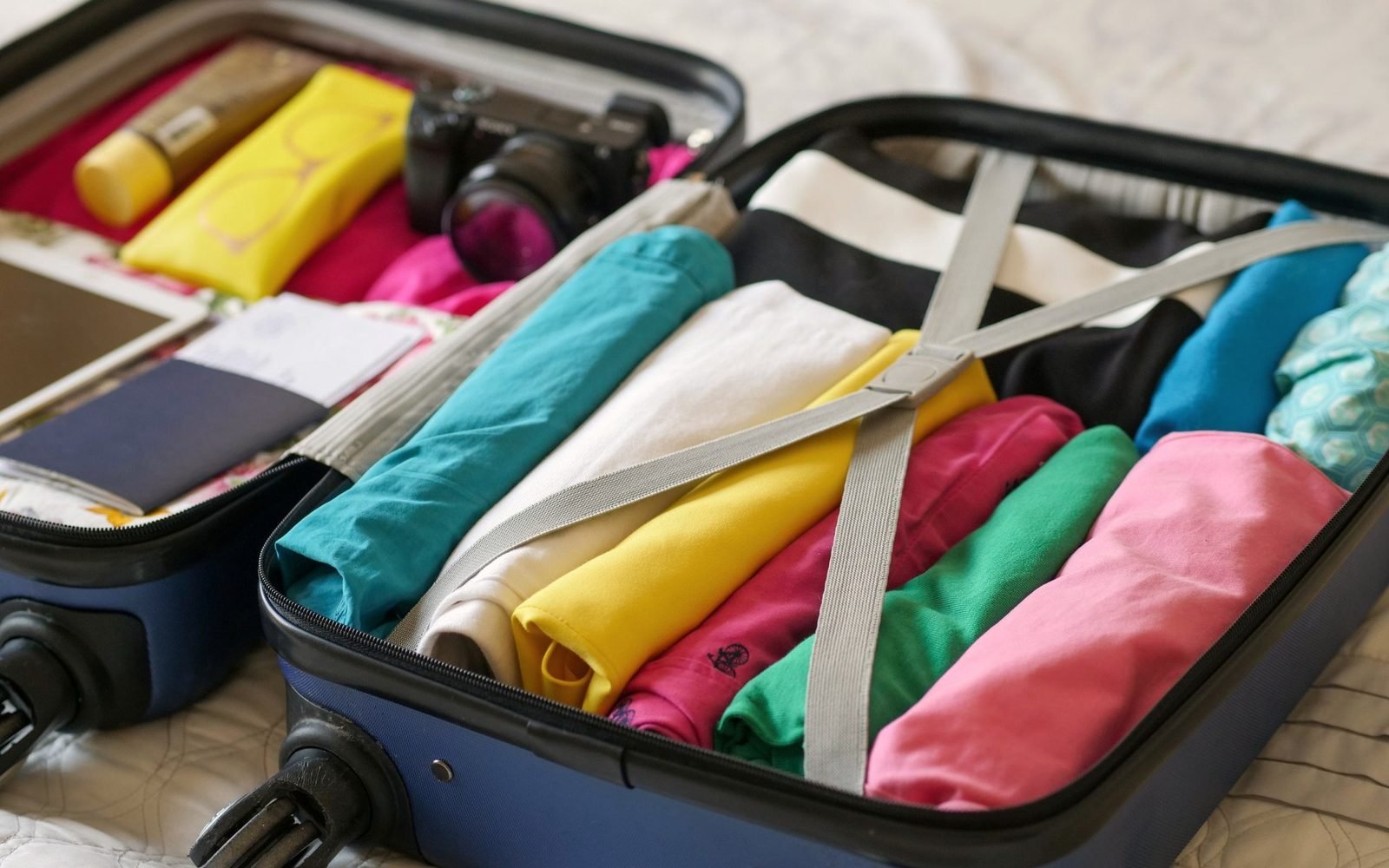
Rolling soft items saves space and reduces creases; folding works better for structured shirts. Many travellers combine both.
Packing cubes
Cubes compress clothes slightly and keep the bag organised, so you can find things without unpacking everything.
Fill the gaps
Stuff socks into shoes, and tuck chargers and small items into corners.
Wear the bulkiest items
Wear your heaviest shoes, jacket and jumper on the plane.
Getting through security smoothly
- Have your boarding pass and ID ready before you reach the queue
- Take out the liquids bag and laptop if the airport requires it
- Wear easy-to-remove shoes and keep metal items in your bag, not your pockets
- Empty your water bottle before screening and refill afterwards
- Keep medicines in their original packaging where possible, and carry any prescriptions
At the gate
On busy flights, overhead space runs out, and late boarders may be asked to check their cabin bags at the gate. To keep your bag with you, board with your assigned group rather than late, and keep it within the airline’s dimensions so it is not singled out. If your bag is gate-checked anyway, take out medication, valuables, documents, chargers and anything fragile, and keep them in your personal item. That is another reason to pack those essentials together in one pouch from the start.
Batteries and power banks
Spare lithium batteries and power banks generally must travel in carry-on luggage, not checked bags, and airlines may limit their capacity. Check the airline’s guidance before packing large power banks or camera batteries.
Carry-on checklist
- Airline cabin bag dimensions and weight checked for every flight
- Bag measured, including wheels and handles
- Liquids in containers of 3.4 oz (100 ml) or less, in one quart-sized bag
- Solid toiletries used where possible
- Medications packed and declared if over the limit
- Capsule wardrobe in two base colours
- Two pairs of shoes, one worn
- Packing cubes or rolled clothes
- Power bank in carry-on
- Liquids bag and documents in an outside pocket
Takeaway
Carry-on travel starts with the rules: TSA’s limit of a quart-sized bag of containers of 3.4 ounces or less, and your airline’s size limits. Plan toiletries first, build a small wardrobe where everything matches, limit shoes to two pairs and plan a mid-trip wash. A week fits in one bag, and you walk straight out of arrivals.